Coordinate systems
In PyTornado there are two different coordinate systems, a body-fixed system and an aerodynamic system.
Body-fixed coordinate system
The body-fixed coordinate system can also be seen as a global coordinate system. The aircraft geometry, the wing forces or the centre of gravity are defined in this system. The longitudinal aircraft axis is expected to be parallel to \(X\). The wing span point in the \(Y\) direction and \(Z\) is upwards.
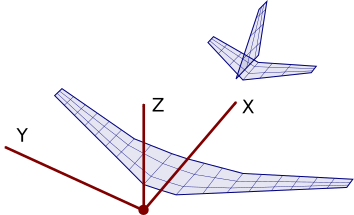
Fig. 9 Body fixed coordinate system
Aerodynamic coordinate system
The aerodynamic coordinate system is only relevant for the lift, drag and side force and the respective coefficients. The freestream direction expressed in the global (body-fixed) system is given as
where \(alpha\) is the angle of attack and \(beta\) is the sideslip angle. The transformation of global loads \(F_x\), \(F_y\) and \(F_z\) into the aerodynamic system is given as
where \(F_D\), \(F_C\) and \(F_L\) are drag, side force and lift, respectively.
See also
- [Drela2014]
TODO Explain (directions, illustration, angle sign convention)